
About
Digital research and digital humanities (DH) projects face many archiving challenges. Web hosting can be expensive to maintain, and projects are often built without long-term preservation of the work in mind. Current static web archiving crawlers also fail to capture the look, feel, and functionality of a significant amount of dynamic content, including interactive maps, visualizations, database-reliant websites and social media content.
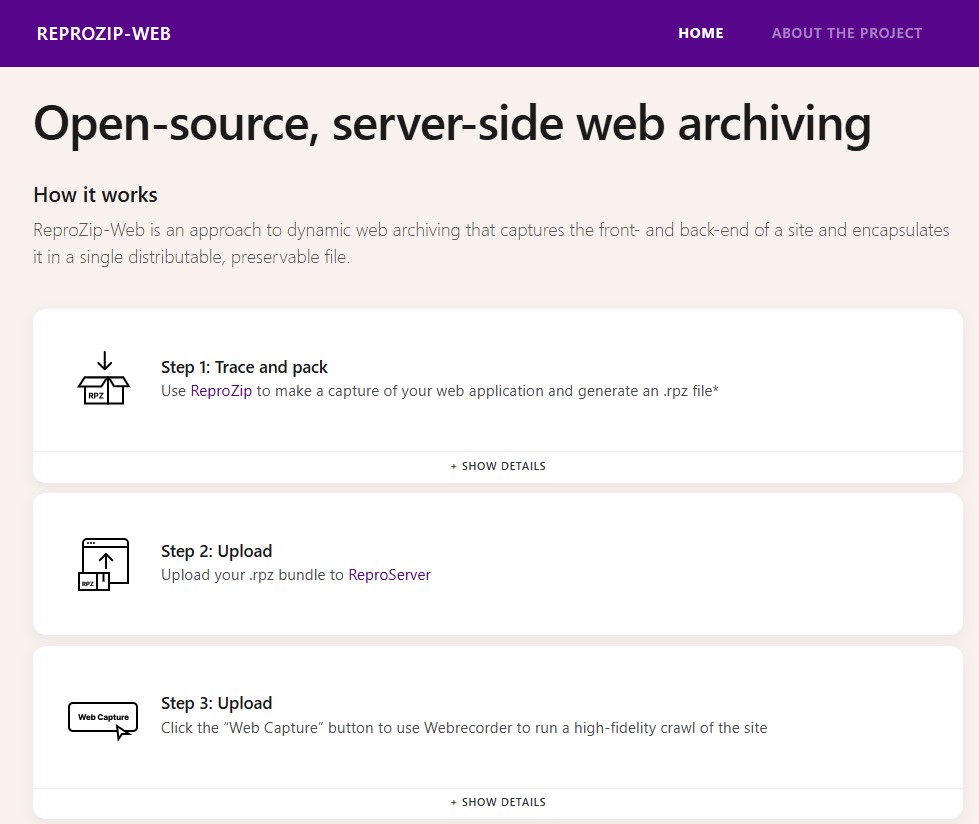
A new grant-funded web-archiving tool, ReproZip-Web, addresses this need. By leveraging the crawling functionality of Webrecorder with the ability to encapsulate a dynamic web server software and its dependencies, ReproZip-Web creates a self-contained, isolated, and preservation-ready bundle with all the information needed to reproduce a digital project. This bundle, an .rpz file, contains all of the files and software dependencies required to replay the project, including the source code, the computational environment (e.g., the operating system, software libraries) and files used by the app (e.g. data, static files). Its lightweight nature makes it ideal for distribution and preservation.
The keynote is given by Katherine Boss, senior librarian and curator for the online archives at the National Library. The presentation will be followed by time for questions and mingling.
You can read more about Repro-Zip for Archiving and Preservation of Digital Projects and Other Complex, Dynamic Websites at the BærUt! blog.
Register
Please register for the event on Pindena.
Victuals
We will serve hot and cold beverages & nibbles.
Host
The presentation is organized by BærUt! Network and Skills Hub for Sustainable Digital Scholarly Editions and ReproducibiliTea.
BærUt! is a competence hub at the University of Oslo for promoting digital scholarly editions (DSEs). Our ambition is to consolidate expertise and knowledge in the field, gather researchers and practitioners, and, in the long run, create the foundation for a common platform for digital editions. We work closely with researchers, developers, and cultural institutions to digitize historical and cultural text documents and ensure these resources are accessible and useful for academic use.
ReproducibiliTea is a global journal club initiative that focuses on discussing papers and ideas about improving science, reproducibility and open research. Our local ReproducibiliTea at the University of Oslo is open to both staff and students at UiO across all departments.

Contact
For questions, please contact BærUt!