Access to EndNote
Students and staff at the University of Oslo and Oslo University Hospital have free access to EndNote. EndNote is compatible with Windows and MacOS and can be used with both Microsoft Office and OpenOffice.
If you have an older version of EndNote and are about to install a new version, it is important to uninstall the older version first.
University of Oslo
For your own PC or Mac
You have three different options:
- Download EndNote from UiO for Windows or Mac.
- Application kiosk gives you access to your home area and a large amount of programs without having to install the programs on the machine you are using.
- Remote Desktop is a tool that you use to remotely log on to computers, so you can access to a computer other than the one you are sitting at.
If you need help, please contact UiO IT services.
On UiO owned computers
You can find EndNote on most computers on campus:
- PC: Start > EndNote > EndNote
- Mac: Finder > Applications > EndNote > EndNote
If you cannot find EndNote, you can can install it:
Oslo University Hospital
For your own PC or Mac
To install EndNote on your personal computer og Mac:
- Go to the following web page: http://www.alfasoft.com/no/endnote-hso.html
- Register with your work e-mail address. Private e-mail addresses does not work. It is important that you register with an adress that ends with either sshf.no, siv.no, sthf.no, ahus.no, ous-hf.no, sykehuset-innlandet.no, so-hf.no, vestreviken.no, sunnaas.no, sykehuspartner.no, kreftregisteret.no, rr-research.no eller oslo-universitetssykehus.no.
- After registering you will recieve an e-mail. Check your spam mail if you have not recieved this e-mail. Foreward the e-mail to a private address you can read on your personal computer or Mac. Follow the link in the e-mail.
- You can log on to the Alfasoft support center at any time. There will be a category named "Helse Sør-Øst HF" where you will find your licence letter and instructions for downloading and installing EndNote.
OUS computer
You can find EndNote on most computers at the hospital:
Start > Mine administrative programmer > EndNote OUS
Have you recently upgraded to Windows 10? After upgrading, you will no longer have access to EndNote until you do the following:
- Go to "Min Sykehuspartner" and "Bestille tilganger (BAT)"
- Search for "EndNote OUSHF Win10" and select it.
- Press "Bestill" and you will automatically be granted access.
- Wait a while (3 hours) and log off and then on again.
You will now have access to EndNote, Word with EndNote, PowerPoint with EndNote.
In case of problems, please contact Sykehuspartner by phone: 32 23 53 30
Start using EndNote
Start the EndNote program:
- UiO: Start > EndNote > EndNote
- OUS: Start > Mine administrative programmer > EndNote OUS
- Mac: Finder > Applications > EndNote > EndNote
You must accept the licence agreement the first time:
- I accept the licence agreement.
- Next.
If the "Welcome to EndNote" window pops up, you can choose to create an EndNote Online account, but this is not required to use the EndNote program. You can also do this later. Learn how to create an account here. Click on the X in the corner to close the box.
If a window pops up asking you to update EndNote, you can close that too.
Create a library:
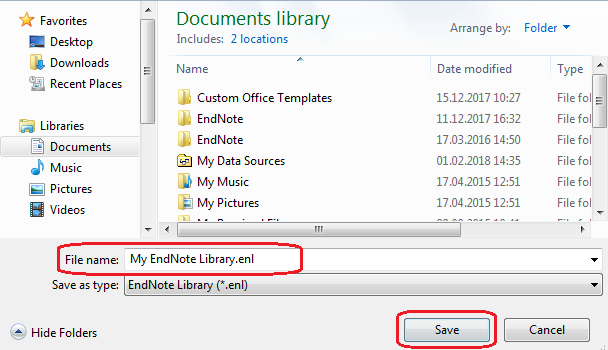
- Choose File > New…
Windows:
Mac:
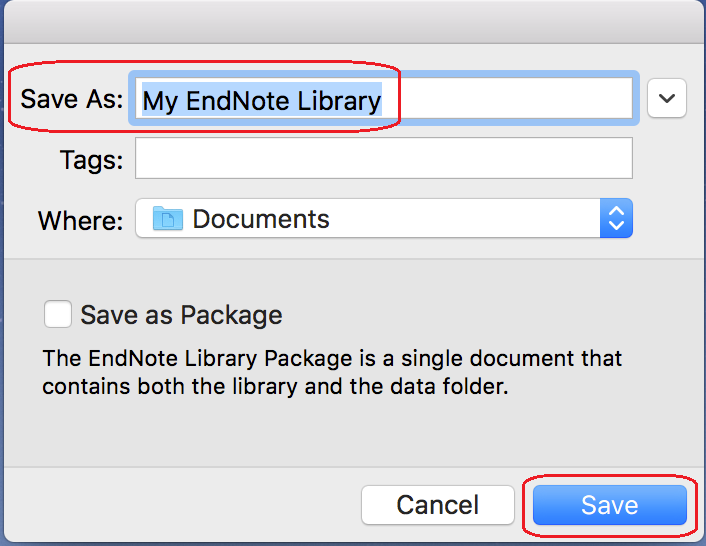
- Name your library. "My EndNote Library" is the default. Change this to avoid clutter.
- Choose where you want to store your library. We recommend saving to your UiO / OUS home area. The library will be available from other machines on the same network. If you work on your own PC / Mac you can save to Documents or other suitable places. Do not store your library in Dropbox, OneDrive, iCloud or other cloud services.
- Save
About the EndNote Library file and data folder:
- An EndNote library consists of an enl file (the database itself) and an associated data folder that share the same name and location.
- The data folder contains all files in the library (pdf files of articles or figures and images that are attached to the references in the library).
- The enl file and the data folder must always be stored in the same place for the library to function. If you need to copy or move the library, both files must be included.
Sync your EndNote library to EndNote online
EndNote offers an option to sync one of your libraries from EndNote Desktop to its online version. You use your library online on various computers, share it and collaborate with others.
Read more about syncing to EndNote Online
Journal Names
Different citation styles have different rules for how journal names should be written. EndNote keeps track of this for you, but you need to provide a list of journal names for it to do so.
NOTE! Your EndNote library automatically adds journal names when you import a reference, but it does not include all spellings. If you already have a partial list in EndNote, delete all entries before importing a new list.
Importing Journal Lists:
- Library – Define Term Lists
- Select Journals and Import Lists…
- You will be directed to a folder with files on various topics; choose the one that is closest to your field (e.g., Medical for medicine and health sciences) and select Open.
- If you're not automatically directed to the folder, navigate to it using the following path:
- PC UiO: C:\Program Files (x86)\EndNote 21\Terms Lists
- Mac: Applications > EndNote 21 > Terms
- Once the file is selected and opened, you will be notified that “X number of terms inserted into the ‘Journals’ term list”
- You can add as many lists as you like, but if you try to add the same one twice, it will just say that “No terms inserted.”
This setting is tied to your EndNote library, so each time you create a new library, you need to import the list again.
EndNote Interface
Layout
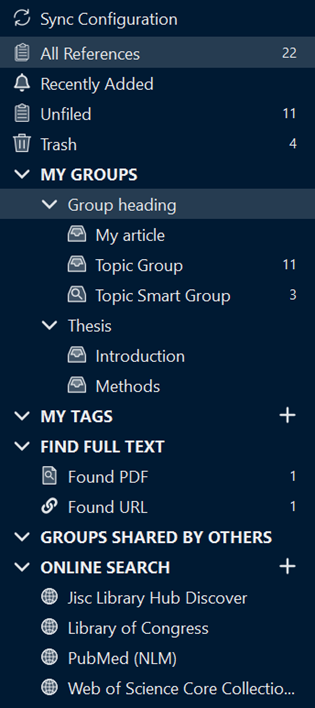 The group panel on the left is used to organize your library in groups. It displays your custom groups and group sets, groups shared by others, as well as EndNote’s default folders, such as recently added references, references used in an opened document and deleted references.
Find Full Text displays results from an automated full text search.
The Online Search presents a selection of databases to search for references, directly via EndNote.
The reference panel in the center displays a list of the references in your library / selected group. You can change the order of the columns and select other display fields by selecting from the top menu:
Windows: Edit > Preferences > Display fields
Mac: EndNote > Preferences > Display fields
Right above the list of references there is a shortcut menu for selected tool in EndNote. All these and more you can find in the program’s main menu at the top. If you hover your indicator over the individual buttons, you will get information on their action. From left to right:
- Insert the selected reference(s) into an opened Word document, at the site of the indicator
- Add a new reference manually to this group
- Share this group with others
- Export this reference to a file
- Find the full text to the selected reference(s) automatically
- Create a citation report of the selected reference(s)

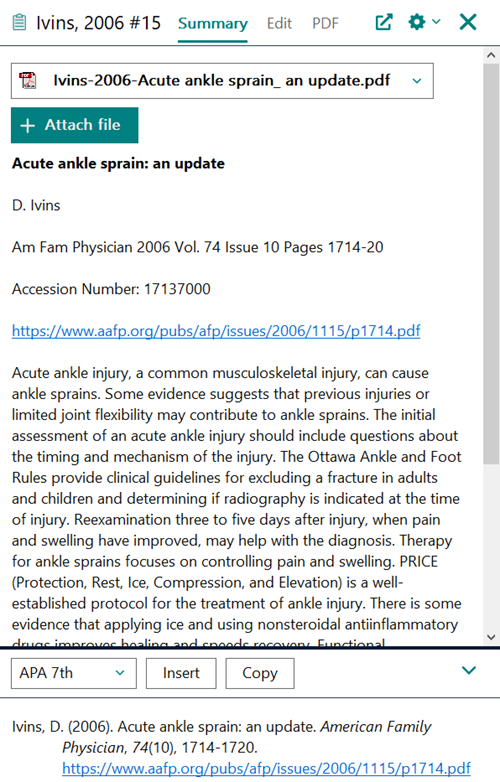 The view panel on the right opens if you select or double click a reference. It includes the tabs Summary, Edit og PDF.
Summary is divided into two sections and presents an overview of the selected reference in the top section as well as a preview of the reference in the selected reference style in the lower section. The chosen reference style only applies to the preview. To change the Output style of your document, see the EndNote and Word guide.
The Edit tab is used to make changes to the reference, the PDF tab displays a PDF, if attached.
The search field at the top is used to find references in your library, either by using the search field in the Simple Search or several fields in the Advanced Search.
Settings
If you change the settings, the change only applies to the machine you are on and to the same user. To change the settings, open Preferences in EndNote:
Windows: Edit > Preferences
Mac: EndNote > Preferences
Below are some recommended settings:
Display Fields - Use the drop-down menus to select which fields from the references to be visible in the reference panel (eg: Author, Year, Journal, Title).
Duplicates - Tick the Author, Year, Title, Volume and Issue fields. This allows EndNote to use these fields to find references that appear multiple times in the library.
It is important to remove these before you start using the references in Word. EndNote has its own feature for this. [lenke]
Find Full Text - Check all boxes and enter the following address in OpenURL Path: http://openurl.bibsys.no/openurl This makes it easy to look up references in Oria.
PDF Handling - Choose to rename the PDFs when importing. This makes it easier to recognise the PDFs outside EndNote.
It is also possible to select the automatic import of PDF files from a specific folder (eg Downloads).
Sync (connect to EndNote Online) - Here you can register as an EndNote Online user by pressing Enable sync and Sign Up. If you already have an EndNote Online account, you can log in with your username and password. After this, the library in the EndNote program and the EndNote Online library will be synchronized. Read about EndNote Online here.