Course and workshop calendar
Ongoing

Are you working on an assignment and need help with managing your references? Come by and ask us!
Upcoming

Is it difficult to set aside time to write? The Academic Writing Centre organises structured writing sessions for PhDs and postdocs.

Bring your research visualisation project, work on it, and get help along the way. Sessions start with a introduction to visualisation principles, data visualisation or a related topic, followed by time to work on your own project, get feedback and explore BioRender.

Are you curious about how ChatGPT and other large language models work? Do you want to get started using AI tools in a responsible way? This course will give an introduction to AI and Large Language Models (LLMs) like ChatGPT, Gemini Notebook and Gemini.

Stop losing notes and start connecting knowledge. This workshop introduces Obsidian, a powerful and highly customizable tool for organizing research, writing, and information in one private, searchable knowledge base.

The course is an introduction or refresher on how to search for scientific journal articles in PubMed.

Is it difficult to set aside time to write? The Academic Writing Centre organises structured writing sessions for students, PhDs and postdocs.
Join us for a series of sessions focused on managing research data throughout the research lifecycle. We will explore practical approaches to organising, documenting, storing, sharing, and preserving research data, with the aim of improving data quality, supporting collaboration, and making research more reproducible.
In this half-day course in research data management, participants will gain insight into planning for data storage, organisation and documentation and working with Data Management Plans.

Do you have a deadline coming up? Is it hard to get started, or stay focused, on writing? Join us at the Science Library for a structured writing session to help you put your words on paper. No distractions, no excuses!
In this half-day course in research data management, participants will gain insight into the potential in archiving and reusing research data in line with the FAIR (Findable, Accessible Interoperable, Reusable) principles.

This course teaches basic referencing techniques such as quoting a text, writing citations and reference lists, and using images.
NVivo is a complex software for qualitative research that can be used to code text, surveys, sound, image, and video.
A hands-on workshop for developing and sharing a Data Management Plan for your research.
Learn how to work in TSD on a virtual TSD Windows machine, specifically with NVivo, a complex software for qualitative research that can be used to code text, surveys, sound, image, and video.
ReproducibiliTea is a global journal club initiative that focuses on discussing papers and ideas about improving science, reproducibility and open research. Our local ReproducibiliTea at the University of Oslo is open to both staff and students at UiO across all departments.
Welcome to the ReproHack: a special edition of ReproducibiliTea! This autumn we invite you to a special event: a 3-hour hackathon at Digital Scholarship Center where we will be reproducing results from research studies.
Is it difficult to set aside time to write? The Academic Writing Centre organises structured writing sessions for PhDs and postdocs.

Hands-on Carpentry@UiO workshop with queries and database principles using SQLite.

This course gives a short introduction to the reference management software Zotero.
Bring your research visualisation project, work on it, and get help along the way. Sessions start with a introduction to visualisation principles, data visualisation or a related topic, followed by time to work on your own project, get feedback and explore BioRender.
Join us for the Life Science Writing Club in the new Life Science Building! These afternoon Shut Up & Write sessions are reserved for all researchers, Postdocs and PhD-candidates within life sciences.
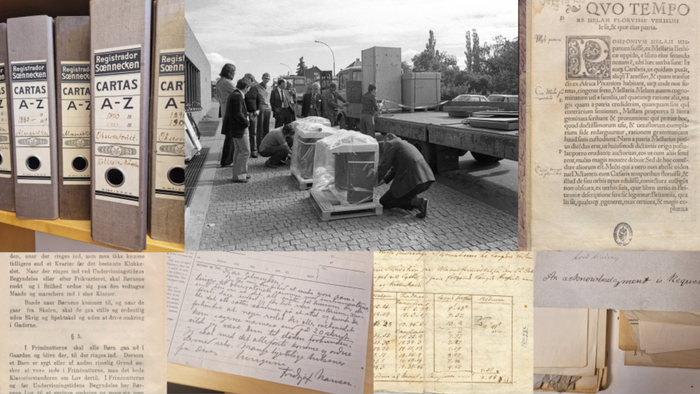
This course is meant to help you make the most of your historical sources by using Tropy, a digital tool that simplifies the process of organizing and annotating them so you can easily find again exactly the ones you need when it comes to writing your thesis or research article.Tropy is a free, open source program that is available for Linux, Max and Windows.
Is it difficult to set aside time to write? The Academic Writing Centre organises structured writing sessions for students, PhDs and postdocs.

Get your work done in less time and with less pain: The Unix shell helps you automate repetitive tasks and easily combine smaller tasks into larger, more powerful workflows.
Do you have a deadline coming up? Is it hard to get started, or stay focused, on writing? Join us at the Science Library for a structured writing session to help you put your words on paper. No distractions, no excuses!

The aim of this course is to equip you with the knowledge and skills to critically appraise the methodological quality of a research article.
This course provides a fundamental understanding of what text mining is and an introduction to available text mining tools. Learn how to text mine a corpus of your choice and with your choice of tool.

Are you using AI tools in your research? Have you thought about how to declare AI use in publications?

This course identifies the “kappe” as a distinct element of the full body of work in an article-based PhD dissertation and offers conceptual and practical perspectives on how to position the “kappe” and how to write it.
Is it difficult to set aside time to write? The Academic Writing Centre organises structured writing sessions for PhDs and postdocs.
This course gives a short introduction to the reference management software Zotero.
Bring your research visualisation project, work on it, and get help along the way. Sessions start with a introduction to visualisation principles, data visualisation or a related topic, followed by time to work on your own project, get feedback and explore BioRender.

In this workshop, you will learn how to work with old maps in QGIS. We will geo-reference such maps, and extract relevant information so we can use it to make new maps.
Is it difficult to set aside time to write? The Academic Writing Centre organises structured writing sessions for students, PhDs and postdocs.
Do you have a deadline coming up? Is it hard to get started, or stay focused, on writing? Join us at the Science Library for a structured writing session to help you put your words on paper. No distractions, no excuses!
Is it difficult to set aside time to write? The Academic Writing Centre organises structured writing sessions for PhDs and postdocs.

Digital Scholarship Days is an annual event designed for anyone working with research who wants to expand their knowledge of digital methods and tools, generative AI, machine learning, open research, research data management, and much more!

Are you curious about how ChatGPT and other large language models work? This course will give an introduction to AI and Large Language Models (LLMs) like ChatGPT, Gemini Notebook and Gemini
Learn how to customize and automate Nettskjema questionnaries to fit your workflow
A hands-on workshop to build and experiment with virtual networks and Software-Defined Networking (SDN)
Classifying Large Text Corpora
A hands-on introduction to coding agents inside your editor, with the AI models of your choice: from your first agent session to reproducible, citable analysis code, including code you can run on sensitive data in TSD
Discover the infrastructure available for research computing provided by UIO
Case based study of relational database data modeling
What does your writing practice look like, and is it suitable for the work you (want to) do?
A free, open-source program to organise and annotate your archive photos
A go-to-guide with tips and tricks for how to share your research data
Learn to develop more control over your academic writing
How to use an (Open Source) software tool with LLMs provided by the university to get work done more efficiently
A Hands-On Full-Day Seminar
A hands-on workshop on using Python and PyGMT to visualize, map, and analyze geospatial data for scientific research and spatial interpretation
Explore why semantically relevant information is not always reliable or appropriate, and learn practical ways to evaluate retrieval quality in AI systems
Make historical manuscripts and prints from any era and in any language and script machine-readable with the web application Transkribus
Learn how to create a data management plan to be shared in your research group
Collaboration-focused workshop on how the Omnipy Python library can provide structure, transparency and accountability to the human/AI-agent interaction when fetching, investigating, wrangling and analysing research data
We will walk you through the basic principles of data anonymization and share strategies for both pseudonymization and anonymization of personal data
Who owns the code that AI wrote?
Building shiny apps in the Norwegian context
Hands-on Carpentry@UiO workshop with queries and database principles using SQLite
Markdown is a markup language – a simple to use, easy to learn way to have greater and more efficient control over your work
Learn about what project management is and how to apply it in your research
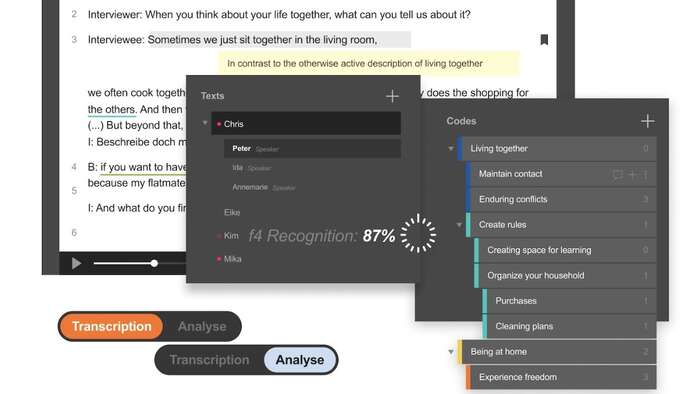
f4 is a qualitative text analysis tool (or CAQDAS) specifically developed for audio and video transcriptions. You can import transcriptions of media files that have been automatically transcribed with UiO’s Autotekst, into f4 where you can edit, code, and analyze them.